You are here:Home / News / Technology Support / Self-Operated Pressure Regulating Valve: Working Principle And Selection Guide
Self-Operated Pressure Regulating Valve: Working Principle And Selection Guide
Views: 0 Author: Site Editor Publish Time: 2026-03-29 Origin: Site
Introduction: A Smarter Way to Control Pressure Without External Energy
In industries such as oil & gas, chemical processing, power generation, and HVAC systems, stable pressure control is critical to ensure safety, product quality, and energy efficiency.
However, many real-world applications face a common challenge: No access to electricity or compressed air
This is where the self-operated pressure regulating valve becomes the ideal solution.
Without any external power supply, it uses the energy of the process medium itself to automatically regulate pressure—making it a reliable, energy-saving, and maintenance-friendly choice for modern industrial systems.
What Is a Self-Operated Pressure Regulating Valve?
A self-operated pressure regulating valve is a type of control valve that operates independently of external energy sources.
Instead of relying on electric or pneumatic actuators, it uses:
Process pressure
Flow changes
Temperature variations
to automatically maintain a preset pressure value.
In simple terms, it acts like a built-in intelligent pressure controller, integrating:
Sensing
Control
Actuation
into one compact unit.
How Does a Self-Operated Pressure Regulating Valve Work?
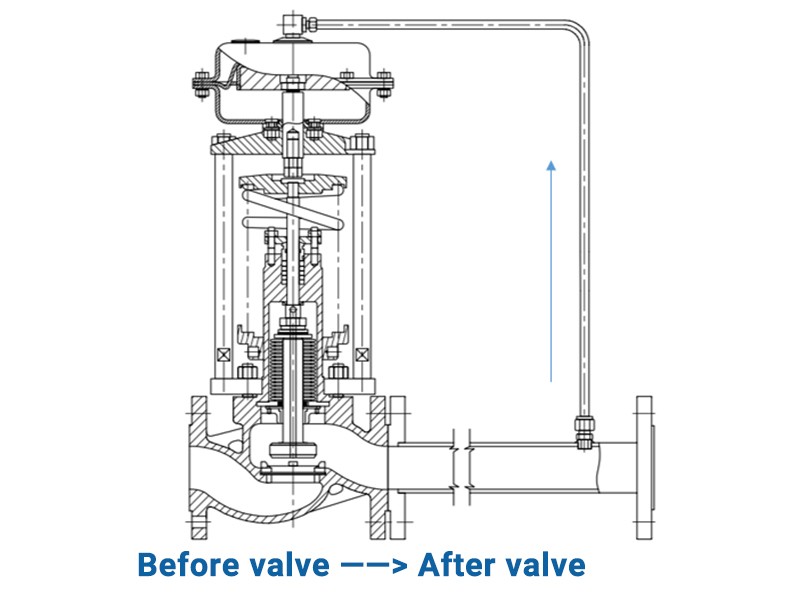
1. Downstream Pressure Control (Type B) – Most Common
This type is designed to maintain stable outlet pressure (P2).
Working principle:
The outlet pressure is fed back to the diaphragm
It balances against the spring force
Valve opening adjusts automatically
Control logic:
Pressure increases → valve closes
Pressure decreases → valve opens
Ideal for:
Steam systems
Water supply
Industrial pipelines
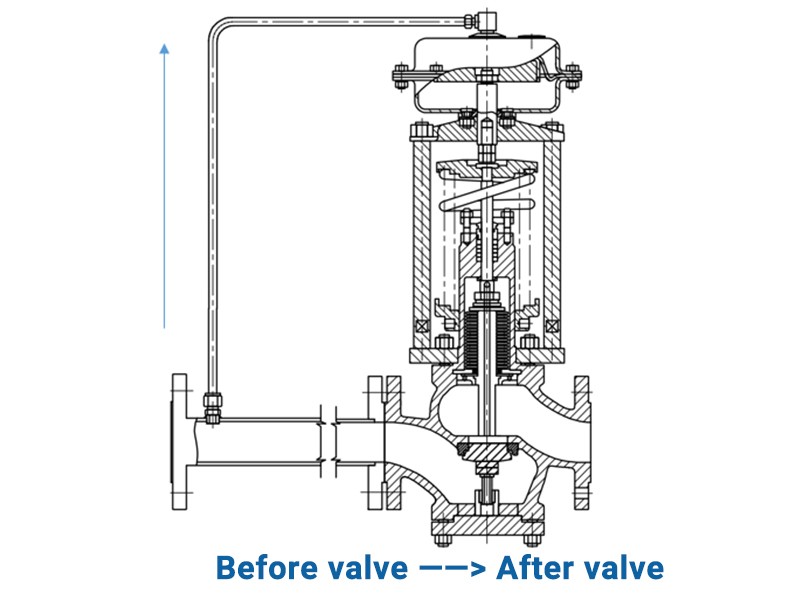
2. Upstream Pressure Control (Type K) – Safety Protection
This type controls inlet pressure (P1) and is mainly used for pressure relief and protection.
Working principle:
Inlet pressure acts on the diaphragm
When pressure rises → valve opens to release excess pressure
When pressure drops → valve closes
Ideal for:
Boiler systems
High-pressure pipelines
Equipment protection
Direct-Acting vs Pilot-Operated Designs
Direct-acting valves:
Simple structure
Fast response
Lower cost
Pilot-operated valves:
Higher accuracy
Better for complex systems
Suitable for larger flow conditions
Why Choose a Self-Operated Pressure Regulating Valve?
✔ No External Power Required
No electricity. No compressed air. Perfect for remote or hazardous environments.
✔ Energy Saving & Cost Efficient
Eliminates energy consumption from actuators and control systems.
✔ Easy Installation
No complex wiring or air piping required.
✔ Low Maintenance
Fewer components mean lower failure rates and reduced downtime.
✔ Automatic Operation
Set the pressure once—let the valve handle the rest.
Technical Specifications
Size Range: DN15 – DN300
Temperature: Up to 350°C
Pressure Ratio: Up to 10:1
Accuracy: ±5% to ±10%
Material Options
Body: Carbon steel / Stainless steel
Trim: Stainless steel
Packing: PTFE / Graphite
Structure Types
Diaphragm type
Piston type
Bellows type
Typical Applications
Downstream Pressure Regulation (Type B)
Steam distribution systems
Water supply networks
Chemical processing lines
HVAC systems
Maintains stable downstream pressure
Upstream Pressure Protection (Type K)
Boilers
Industrial equipment protection
High-pressure systems
Prevents overpressure damage
How to Choose the Right Self-Operated Pressure Regulating Valve
Step 1: Define Your Goal
Need stable outlet pressure → Type B
Need pressure relief protection → Type K
Step 2: Check Operating Conditions
Pressure range
Temperature
Medium type (steam, liquid, corrosive)
Step 3: Select Proper Size
Match DN size with pipeline
Avoid oversizing (causes instability)
Avoid undersizing (limits flow)
Step 4: Choose Structure Type
Diaphragm → general use
Piston → higher pressure
Bellows → sensitive applications
Installation Tips for Optimal Performance
Install valve vertically on horizontal pipelines
Ensure flow direction matches arrow marking
Install pressure gauges upstream and downstream
Keep impulse lines properly positioned
Add filter for dirty media
Use condenser for steam applications
Common Problems and Solutions
Problem: Pressure Cannot Reach Set Value
Possible causes:
Weak spring
Blockage
Internal leakage
Solution:
Replace spring
Clean valve
Repair sealing
Problem: Pressure Cannot Be Reduced
Possible causes:
Spring too strong
Valve too small
Solution:
Adjust spring
Select larger valve
Problem: Pressure Fluctuation
Possible causes:
Oversized valve
Insufficient actuator capacity
Solution:
Resize valve
Add damping device
Conclusion: Reliable Pressure Control Without Complexity
A self-operated pressure regulating valve is more than just a valve— it’s a self-sufficient pressure control solution.
With no external energy required, it delivers:
Stable performance
Lower operational costs
Reduced maintenance
High reliability
Making it the ideal choice for both traditional and modern industrial systems.
Get a Customized Solution
Not sure which self-operated pressure regulating valve fits your system?
Contact usfor a tailored selection based on your working conditions. Our engineers will help you choose the most efficient and cost-effective solution.